
02.26.2026 Brittani Yeager
Estimated Reading Time: 8 Minutes
What if the data your competitors are overlooking is your greatest opportunity to win customer loyalty?
Many companies approach providing identity protection as a checklist – a standard benefit offered to all their customers. But our research shows that where your customers live shapes how they emotionally respond to identity theft and fraud, how much they trust certain providers, and how they respond to protection that fits their needs.
Our latest eBook, Regional Realities Across America: Differences in Identity, Security, and Digital Trust, is the third and final installment in our Identity & Cybersecurity Concerns (ICC) Perspectives series. It draws on data from our 2025 ICC Survey of 1,010 U.S. adults to show how consumers across the Northeast, Midwest, South, and West differ in their views of identity protection, digital trust, and personal online security.
The takeaway for product managers and customer experience leaders? Companies that recognize and act on these regional differences have a clearer path to stronger customer engagement, loyalty, and revenue growth. Here’s what the data tells us.

Key Takeaways
- Demand for identity protection is already strong. While 87% of Americans feel secure using connected devices, 86% are concerned about digital threats, and 66% will pay for comprehensive identity protection.
- Regional differences shape how consumers perceive and respond to identity threats. Concerns, emotional responses to fraud, and expectations for support vary across the country.
- Trust and preferred protection channels differ by region. Banks, insurers, and retailers each hold strong credibility depending on where customers live.
- Tailored identity protection drives stronger engagement. Companies that align offerings with regional needs can build loyalty, deepen customer engagement, and unlock new growth.
What Do Americans Really Think About Identity Security? The National Numbers, Explained
At the national level, the data is encouraging for companies that offer identity protection solutions and services:
-
While 87% of Americans feel secure using their internet-connected devices,
-
86% are extremely or very concerned about at least one digital threat, and
-
66% are open to paying for a comprehensive identity protection program.
Two-thirds of consumers are already open to paying for protection. That’s not a market you need to build – it’s a market ready to be served.
But confidence in online security isn’t evenly spread. Nearly one-third of respondents in the Northeast and Midwest say they feel very secure online, compared to roughly one-quarter in the South and West. In the West, 18% say they don’t feel secure at all – the highest of any region.
Those confidence gaps are addressable. Consumers in regions with lower security confidence aren’t lost causes – they’re high-opportunity audiences waiting for a provider with the right message, tools, and reassurance.

Download our latest eBook, Regional Realities Across America: Differences in Identity, Security, and Digital Trust, for a deeper exploration of how consumers across the Northeast, Midwest, South, and West differ in their perceptions of identity protection, their levels of digital trust, and their sense of personal security online.
Which Cybersecurity and Identity Theft Threats Do Americans Fear Most by Region?
Concern about digital and identity-related threats is nearly universal – which means your customers are already primed to see the value in what you offer. What varies is which threats feel most urgent by region. That’s exactly the kind of insight that makes product positioning smarter.
Southern and Midwestern respondents led in concern across every major threat category:
-
Weaponized AI: 70% of Southerners and Midwesterners expressed extreme concern, compared to 61% in the Northeast.
-
Device hacking: 65% of Southerners expressed strong concern, significantly outpacing the Northeast (53%) and West (54%).
-
Password compromise: 62% in the South vs. 51% in the Northeast and 53% in the Midwest.
-
Fear of being scammed: Peaks in the South at 58% -- nearly 20 points higher than the Northeast (40%).
-
Home title or deed theft: 47% in the South, 10 points higher than Northeastern counterparts.
Think about what this means for your product strategy. A Southern worried about scams, AI threats, and password compromise is telling you which features matter most to them. Lead with those, and you’re not just offering protection – you’re delivering relevance. And relevant protection builds the kind of loyalty that’s hard to replace.
How Does Identity Theft Impact Victims Differently Depending on Where They Live?
One in five Americans (21%) reports being a victim of identity theft or fraud in the past two years. Rates are highest in the South (24%) and West (23%). Combined first- and second-hand exposure peaks in the West at 62%. These aren’t just statistics – they represent real customers who have lost trust and are looking for a solution they can count on.
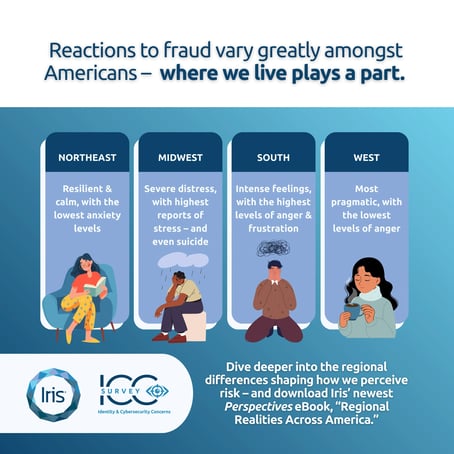
How fraud hits emotionally by region gives you a powerful edge in designing the right response:
-
The South: 68% of fraud victims feel frustration and anger; 41% report elevated anxiety. These customers want to feel heard, supported, and protected. Brands that lead with empathy and visible action earn deep loyalty.
-
The Midwest: 18% say fraud caused more stress than anything they’ve ever dealt with – far above the 9-11% in other regions. This audience values human-centered resolution and genuine support.
-
The Northeast: Post-fraud anxiety is just 10%, with frustration at 52% – the lowest of any region. These customers are composed and confident. Credibility and transparency win here.
-
The West: Westerners want fast, digital-first resolution with minimal friction. Seamless tools and proactive alerts are what this audience responds to.
The resolution gap makes this even clearer. A notable 20% of Northeastern fraud victims had an identity protection company fully resolve their incident – compared to just 5% in the South, 3% in the Midwest, and virtually 0% in the West. Only 10% of Northeast victims spent several days or more on the resolution, versus 45-53% everywhere else.
That gap is your opportunity. In regions where resolution support is lowest and the emotional toll of fraud is highest, embedded, expert-led resolution isn’t a differentiator – it’s a game-changer for customer retention.
Who Do Consumers Trust to Provide Identity Protection – And Are They Willing to Pay for It?
Here’s a key finding: 66% of consumers are already open to paying for a comprehensive identity protection program, with willingness highest in the West (71%). That’s a sizable market – and it grows when providers show up in the right way, through the right channels.
Where consumers place their trust also provides insights into where to embed your offerings:
-
Banks and credit card providers lead in trust across all regions, particularly in the South (66%) – making financial services an ideal channel for embedded identity protection.
-
Insurance carriers resonate most strongly in the Northeast (44%), giving insurers a strong opportunity to deepen customer relationships through bundled protection.
-
Retailers see the highest openness in the West (23%), where digitally native brands have real room to add value through protection features.
When protection is built into the platforms your customers already trust – or even bundled with core, premium offerings – the barrier to adoption nearly disappears. That’s a direct driver of retention, cross-sell potential, and lifetime value.
What Should Companies Do Differently to Meet Their Customers’ Regional Identity Protection Needs?
Nearly one in five Americans (18%) have no identity protection features at all, and access is highest in the West (87%) – leaving real gaps across the rest of the country. For product and experience leaders, that’s a real, addressable market.
The companies best positioned to close it are those willing to move beyond the one-size-fits-all model. As we put it in the eBook: identity theft doesn’t look or feel the same everywhere – and protection shouldn’t either.
At Iris, we’ve built our identity protection platform around exactly this kind of nuance. Our customer-first identity protection offerings integrate seamlessly into your existing systems. They can be shaped to match the trust expectations, emotional needs, and risk profiles of your customers – whether they’re in Atlanta, Chicago, Boston, or Los Angeles.
When you offer the right protection to the right customer at the right moment, you’re not just reducing risk. You’re creating an experience worth staying for. That’s how identity protection becomes a loyalty engine – and a revenue driver.
How Can You Build an Identity Protection Strategy That Works Across Every Region?
Download the full eBook, Regional Realities Across America: Differences in Identity, Security, and Digital Trust, for the complete regional breakdown and see how Iris can help you turn regional insight into personalized protection that drives loyalty, retention, and growth.
Gain Regional Insights Now

Contact us today to start building your perfect identity protection experience.


.png?width=102&height=102&name=Iris-Generali-Logo-White%20(1).png)


