
08.18.2026 Brittani Yeager
Estimated Reading Time: 11 Minutes
As you may have already discovered, the Iris OnWatch identity protection platform opens up the world of identity theft protection and consumer cybersecurity to you – with a new level of flexibility and choice.
If your business is evaluating how Iris can help you offer identity and cyber protection to your audience, it’s vital to choose a fitting customer experience.
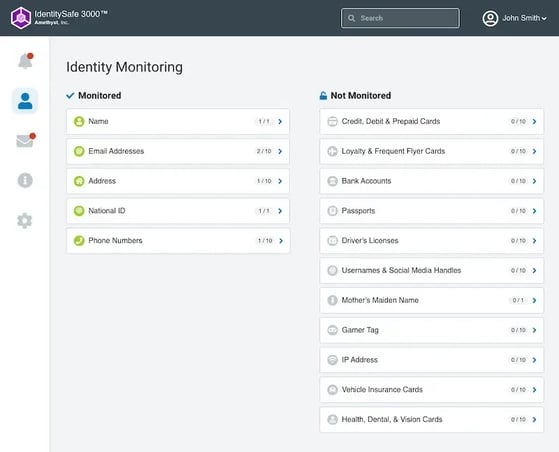 One sample illustration of how you might collect customer information for secure monitoring via the Iris platform in a desktop web experience.
For example, if your customers primarily interact with a digital experience you own, then you may need your identity theft protection features to feel seamlessly identified with your brand.
Alternatively, suppose your core business is in goods or services. In that case, sending customers to a separate web portal may be the best way to signal your identity protection plan as a “bonus” of their relationship with you.
Of course, if the customer experience clashes with your business model, you risk pouring resources into a solution that hardly anyone takes you up on.
That’s why, when you work with Iris, we’re here to consult along the way – to help you craft a truly fitting experience.
Let’s walk through three important factors that should influence the Iris user experience option you choose.
The Essential Choice: Interface Managed by You, or Managed by Iris
Generally, there are two broad approaches to user experiences using the Iris identity protection platform: you can integrate features into a product you manage, or you can redirect customers to a delivery method Iris manages.
And if you choose to integrate features into your own product, you have an additional key choice to make: either you can build the interface yourself, or you can embed an interface built by Iris.
Integrating and Building the Interface Yourself with the Iris API Suite and SDK
Do you wish to offer your identity and cyber protection features within a digital experience that you control – such as your web product, online customer account, or mobile/web app?
And if so, does your development team have the capacity to design, build, test, and maintain the user interface for your Iris-powered features in-house?
If so, the Iris API Suite and SDK may be the best experience option to meet your needs.
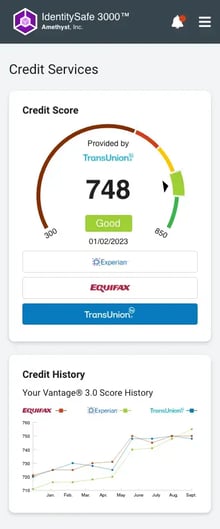 A sample rendering of how you might choose to display customer data supplied through Iris’ Credit Services solution.
Integrating an Iris-Built Interface Into Your Own Product with Iris Micro-Experiences
Are you hoping to offer identity protection features inside your own product – but your development team doesn't have (or doesn't want to spend) the resources or time to develop the entire interface in-house?
If this sounds like your organization, then Iris Micro-Experiences might be the right experience option to choose.
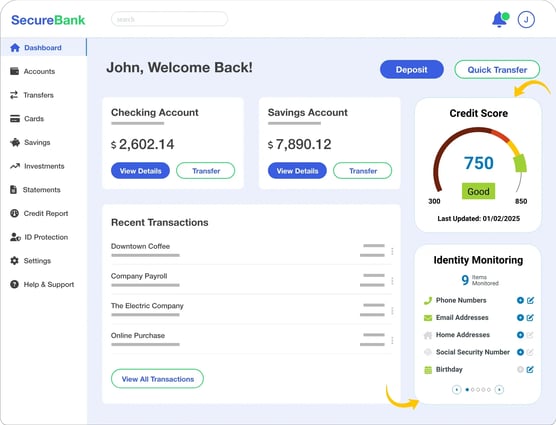 Iris' individual Micro-Experiences can be mixed and matched in your product, enabling a ton of customization so the pre-built components feel as seamless as possible.
Redirecting Customers To An Iris Portal
Alternatively, perhaps your company would prefer another business to host the customer experience that includes your identity and cyber protection solutions – such as a self-contained website your customers can log into that reflects your company’s brand?
If this is your priority, then your organization may be a great candidate for an Iris Portal.
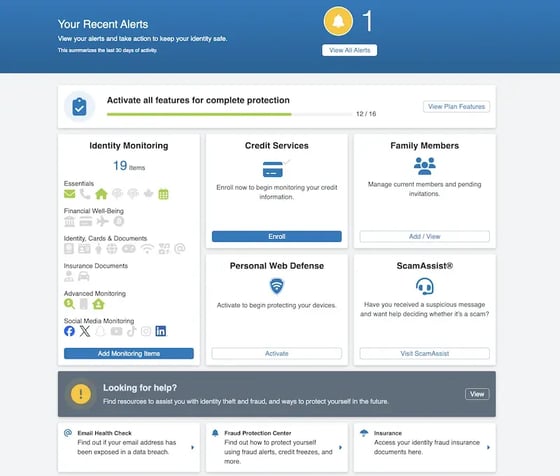 An Iris Portal dashboard with one possible set of features chosen.
All three options offer a wide range of choices and customization.
For many companies, taking time to carefully consider and discuss the three factors described here is essential to determine which approach will yield true and lasting success with your customer base.
The Three Important Factors When Choosing an Iris Experience Option
Factor 1: Customization vs. Convenience
Integrating Iris solutions via API or SDK into your product gives you maximum flexibility over the customer journey, text, design, and all other interface elements.
- This means you will take on the consumer software development and testing, including certain key aspects such as notifications (email, SMS, push, etc.).
- For businesses using the Iris Identity Protection API experience option, the control is worth this technical work.
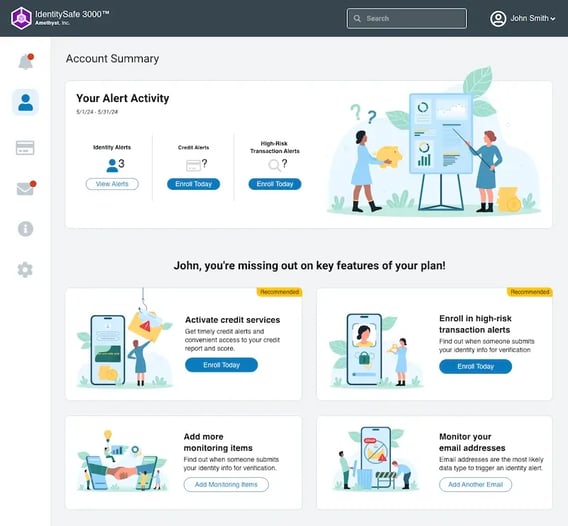
A possible rendering of customer data available through the Iris API Suite – in this case, used to populate a dashboard on desktop.
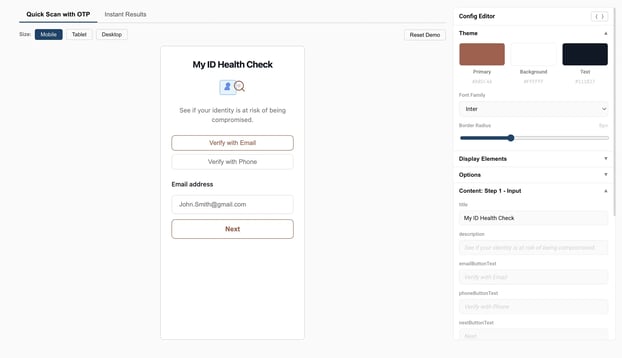 Screenshot of Iris Micro-Experiences configuration of ID Health Check solution configured for a mobile screen with editable elements.
Embedding solutions into your product via Iris Micro-Experiences gives your identity protection features a "native" feel (and faster implementation than the API route!), while relying on Iris for the core component design.
- While this means you don't have full interface control, Iris offers a rich array of configuration options.
- For businesses seeking the most convenient integration, who may have limited resources or a desire for tech development, Iris Micro-Experiences offer a convenience well worth the pre-defined structure.
Finally, an Iris-driven experience option, such as the Iris Portal, relieves you of nearly all user experience design choices. Instead, it involves working with an interface template designed and managed by Iris.
- We are proud of our web portal experience – we continually study and improve it throughout the year. We also offer ample customization to reflect your brand.
- For businesses that go the Iris Portal route, convenience – and typically quick setup – make the templated design worthwhile.
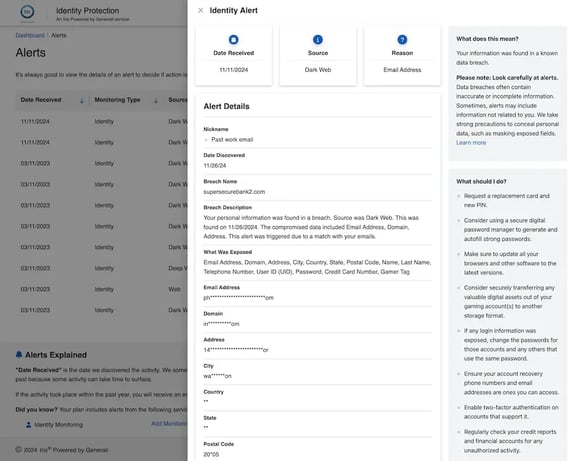 A sample Identity Monitoring alert displayed within an Iris Portal on desktop.
Factor 2: Available Technical Resources
Often, a key factor in which Iris Experience Option our partners select is simply the availability of technical resources.
- These resources include skilled team members, and the necessary software development tools and processes to build, test, and launch your product.
- In some cases, even large organizations with in-house technical resources choose an Iris-managed user experience. Why? These teams may not always be available within the needed scope and time frame to launch a homegrown solution.
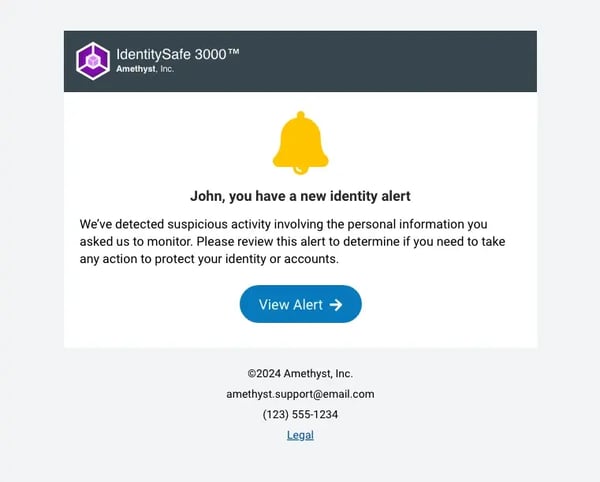 A sample of the kinds of customer notifications you may wish to set up alongside the Iris API Suite to maximize your program’s effectiveness.
Factor 3: Commercial Packaging and Consumer Distribution Model
Beyond the resource investment, your choice of user experience option will likely be affected by your plan for distributing your package to the end consumer.
Here are a few scenarios we encounter.
Scenario 1
Want your identity theft protection experience to feel like a seamless part of your core offering?
The Iris Micro-Experience option is often the most convenient way to achieve that, while the Iris API option offers you the greatest freedom to achieve that.
At the same time, this could be achieved via an Iris Portal, especially with Single Sign-On (SSO) enrollment and login.
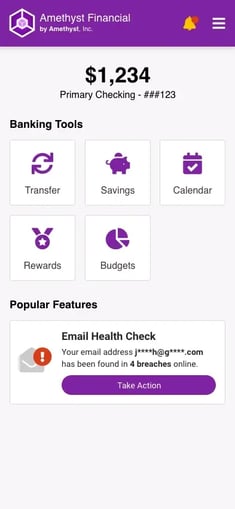
In this example, you’ve positioned Iris’ Email Health Check solution as one feature within your online banking app.
Scenario 2
Want to cultivate a standalone sub-brand for your identity theft protection programs?
An Iris Portal might be good here, as it can give a slightly more “separate” feel from your primary offering.
Alternatively, you could always build your own secondary product, assembled of Iris Micro-Experiences or powered by the Iris API Suite.
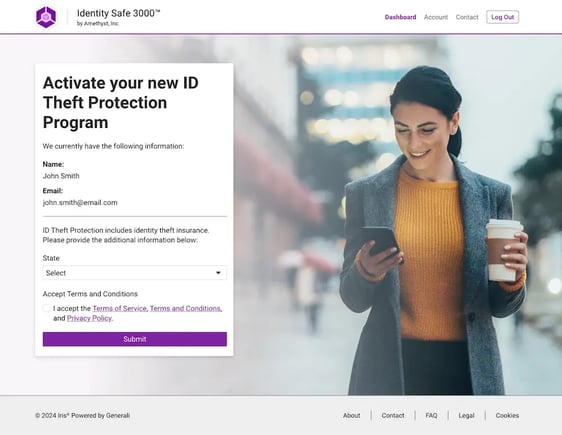
A sample Iris Portal customer enrollment page leveraging Single Sign-On (SSO) enrollment.
Scenario 3
Want your customers to voluntarily sign up for your plan on its own?Here, an Iris-managed interface may have its advantages, due to Iris’ well-developed set of customer enrollment options.
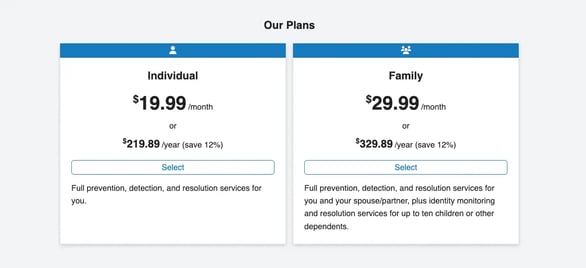
A sample Iris Portal signup experience leveraging direct purchase enrollment.
Scenario 4
Want to give out identity protection as a free or included benefit to your member base?In that case, an Iris-managed interface may be more cost-effective for you given the business goals of offering the package.
Alternatively, Iris Micro-Experiences make it easy for you to provide your desired solutions without requiring any additional consumer "subscription."
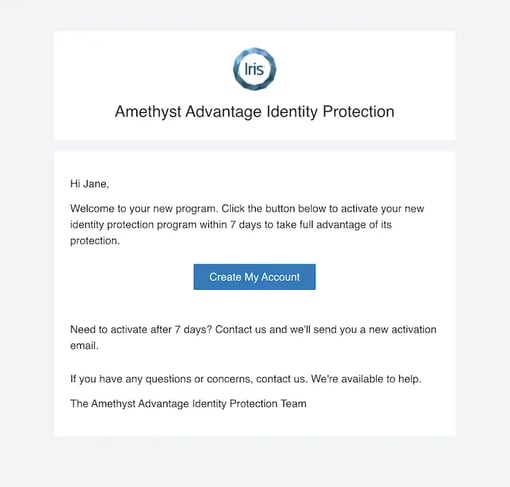
A sample customer enrollment invitation email for an Iris Portal, leveraging API-based enrollment.
Really, all of the above scenarios can be served successfully by either approach. It simply depends on what matters most to you.
Where to Go Next: Explore the Iris Identity Protection Platform Further – and Consult with Us!
We recognize that you want to craft a successful identity and cyber protection experience for your particular audience. Want to discuss with your product, engineering, or development team? Download the infographic to discuss with them.
As you gain a better understanding of our available solutions, customer enrollment options, data handling structures, and security considerations, your ideal experience should become clearer.
At any point during your journey, we encourage you to contact us and discuss what you’re hoping to offer.

Ready to build the perfect identity protection experience for your customers?
Contact us so we can discuss what you're hoping to offer.