
09.24.2026 Brittani Yeager
Estimated Reading Time: 7 Minutes
“Your package is delayed; click here to update your address.”
“Your account is locked; call this number to verify your identity.”
“You missed a toll; copy the payment link into your browser to pay the fee.”
Most of us have gotten at least one of those. You may have even gotten one today.
That’s exactly why October is such an important time of year. It’s Cybersecurity Awareness Month – the annual initiative, led by the National Cybersecurity Alliance and the Cybersecurity and Infrastructure Security Agency (CISA), designed to help everyone stay safe online. This year marks Iris’ tenth year as an official Champion of the month, and our first as Iris OnWatch.
This year’s theme is a good one: “Don’t Make It Easy for Them.”
We love it because it aligns perfectly with Iris’ mission. It doesn’t call for fear; it asks people to be harder to scam – making the consumer the protagonist of these scam stories. As consumers, we can decide how much work a scam takes to pull off.
Right now, the math favors the scammer. People catch plenty of scam messages – many of us delete a few every week without a second thought. But scamming has become fast, cheap, and automated, while staying protected still takes real effort.
For business and product leaders, the theme offers an opportunity worth exploring: brands can make protection effortless for customers.

Key Takeaways
- Americans face an average of 347 scam attempts per person, per year, according to the Global Anti-Scam Alliance’s State of Scams in the USA 2026 report.
- Scams work because they look real: 29% of victims said the situation was convincing and realistic, and 28% said the communication looked genuine.
- 84% of consumers feel secure using their connected devices, but only 29% say they follow all recommended security practices, according to Iris OnWatch’s 2026 Identity & Cybersecurity Concerns Survey.
- 80% of consumers would use identity protection tools built into an app or platform they already use.
What Does "Don't Make It Easy for Them" Mean?
“Don’t make it easy for them” means raising the cost of an attack through small, everyday habits.
Scammers are running a numbers game, so every extra step they run into makes them more likely to move on to something easier. When we rush through everyday security requirements, we reuse passwords, click quickly, and get distracted by the urgency life often demands. These simple habits can make life harder for scammers – and keep you and your family protected.
Iris champions Cybersecurity Awareness Month and these simple security habits everyone can employ:
-
Use strong passwords for sensitive and important accounts
-
Turn on multifactor authentication (MFA) for an extra layer of security
-
Update software and consider automating your apps’ software updates
-
Recognize and report phishing, because reporting scams helps others avoid the same ones

You don’t have to be a security expert to use these cybersecurity basics. Anyone – from young adults to seniors – can take these small steps that raise the cost of an attack, keeping them and their community safe from online threats.
Why Has Scamming Become So Easy to Do?
Scams have become easier to do because nearly every step is automated, polished, and sped up.
Let’s start with volume. Americans encounter an average of 347 scam attempts per person, per year – just under one a day, according to the Global Anti-Scam Alliance’s (GASA) State of Scams in the USA 2026 report, sponsored by Iris OnWatch. Casting a wide net costs a criminal almost nothing.
Then there’s crafting these scams. When GASA asked Americans who lost money how the scammer pulled it off, the scam’s believability was a major factor in how often it worked: 29% said the situation was convincing and realistic, and 28% said the communication simply looked genuine. As Paige noted at the Summit, artificial intelligence has poured fuel on this: “AI is a speed multiplier. It’s just going to get more creative and more crafty.”
When it comes to scams, your customers are up against threats that are fast, believable, and easy to repeat.
Why Does Staying Protected Still Take So Much Work?
Staying protected in a highly digital world takes so much work because most people have to assemble protection themselves, one piece at a time.
Iris’ own 2026 Identity & Cybersecurity Concerns (ICC) Survey found that 84% of consumers feel secure using their internet-connected devices, while only 29% say they diligently follow every recommended cybersecurity practice. But let’s be honest, following every cybersecurity recommendation across every account can feel like a part-time job.
Plus, the tools people do have tend to be scattered – credit monitoring from one provider, dark web monitoring from another, maybe a VPN from somewhere else entirely. What’s more, none of these tools connect in one place. In the ICC survey, we found that:
-
22% of consumers said they had access to none of the protection tools we asked about, up from 18% the year before.
-
Access to scam support specifically fell from 28% in 2025 to 14% in 2026.
And when that level of patchwork exists, recovery can prove even more challenging:
-
Only 6% of surveyed consumers had resolution support to turn to.
-
36% spent several days or longer sorting things out.
-
45% described the recovery process as difficult.
None of this reflects poorly on the protection that does exist – those tools work well. Finding them, choosing between them, and setting them up is the work. And with the right partner, that’s a problem brands can solve – easily.
How Can Brands Make Protection Easy and Scams Harder?
Brands can help make scam and identity protection easy by filling two roles: frontline educator and value-added organization.
The first role is already proving successful. GASA asked Americans what has helped them recognize or avoid scams, and information from their own bank or payment provider ranked third (23%), behind personal experience (30%) and word of mouth (26%). Practical guidance from familiar brands is well received, and October is a natural time to send it.
The second role presents a bigger opportunity: standing out as either a household name or a market leader by making identity and scam protection accessible and integral to the business.
In our ICC survey, we uncovered:
-
80% of consumers said they would use identity protection tools if they were integrated into an app or platform they already use – such as a banking app, an online insurance customer account portal, or a telecom service.
-
38% said they would prefer that format.
-
18% said they would prefer a standalone or dedicated identity protection experience.
-
-
65% said they would pay for comprehensive identity protection.
Embedding protection directly into your digital experience can offer seamless protection. But a well-placed web portal still works well – particularly when it’s white-labeled, reachable through single sign-on, and featured prominently in the account or app your customers already use. What matters is that protection is somewhere your customers can easily find it.
Paige offered this perspective at last month’s Summit: “It’s also about accessibility – to all the tools that are out there, all the education resources, all the technical tools. When people are working in environments they’re already comfortable in, they’re more likely to enroll or engage.”
There’s a third piece worth flagging: making it easier to report a scam when one slips through your customers’ defenses. Reporting should be easy to find, do, and track – something every brand, platform, and government agency can help with.
Where Do People Turn When Something Goes Wrong?
The answer to where people turn when something goes wrong may surprise you – and it’s the subject of our next conversation.
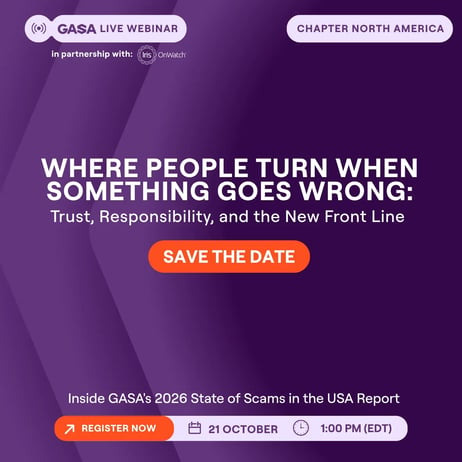
On Wednesday, October 21, Iris OnWatch and GASA will bring together a live panel discussion on “Where People Turn When Something Goes Wrong: Trust, Responsibility, and the New Front Line.” Our panelists will unpack what the 2026 State of Scams in the USA data reveals about the shift in consumer trust after encountering a scam – and what that means for the businesses that respond to that trust.

This October, let’s make it harder for scammers – and easier for everyone else.

Where People Turn When Something Goes Wrong: Trust, Responsibility, and the New Front Line
If you’re responsible for product, product strategy, or customer experiences, this webinar is for you. You’ll leave with fresh insights and ideas to bring into your 2027 planning.